Every few years, a new narrative emerges in the enterprise world: some old technology is "dead," and a new one is about to replace everything.
The 2026 version: "RPA is dead; the age of AI Agents has arrived."
That's not entirely right — but not entirely wrong either.
What RPA Does, and Where It Gets Stuck
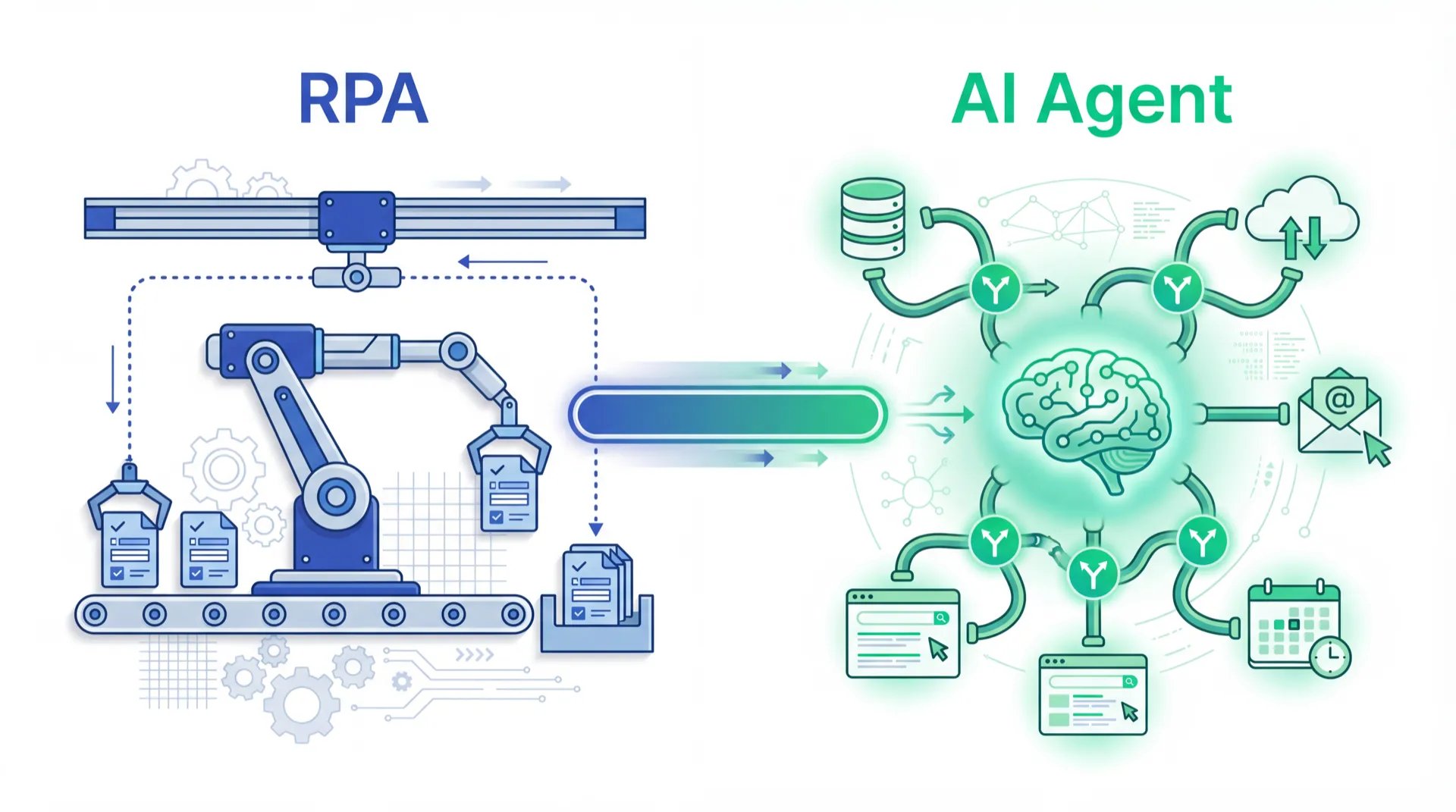
RPA (Robotic Process Automation) is an intuitive concept: delegate repetitive computer tasks that employees perform to software robots. It mimics human actions — clicking buttons, copy-pasting, filling forms, moving data. Give it a script, and it executes without fatigue, error, or delay. For monthly accounting reconciliations, HR payroll generation, and procurement invoice verification, RPA genuinely saves enormous labor hours.
But RPA has a structural limitation: it can only handle tasks with clearly defined rules and fixed processes. Once it encounters a UI redesign, format changes, or exceptions requiring judgment, RPA stops cold. It doesn't understand what it's doing — it just follows scripts, and anything not in the script leaves it helpless.
Forrester research shows that only about 30% of enterprise processes are fully structured and suited for RPA. The remaining 70% involve unstructured data, ambiguous judgment calls, or conditional logic across systems — precisely the most labor-intensive parts.
What Makes AI Agents Different
An AI Agent is an AI system capable of understanding goals, autonomously planning steps, and making contextual decisions. It doesn't follow a script; it understands what you want it to achieve and finds its own path.
The difference is most apparent in handling exceptions. Consider a procurement scenario: invoices from suppliers come in inconsistent formats — some PDF, some Excel, some scanned images, with amount fields in different locations for each vendor.
RPA's approach: write a separate rule set for each format. New format arrives, write another set. Slight format changes break the script, accumulating maintenance costs.
AI Agent's approach: it reads invoice content regardless of format variation, extracting vendor name, items, amount, and date, then cross-referencing against past procurement records to flag anomalies. New format? It adapts. Amount doesn't match the quote? It flags for human review.
This isn't a feature difference — it's a capability-level difference. One "follows instructions," the other "understands your standards."
But AI Agents Aren't Omnipotent
Gartner estimates that thousands of vendors claim to offer AI Agents, but only about 130 have genuine autonomous reasoning and action capabilities. This phenomenon has a name: Agent Washing — just like "AI Washing" a few years ago, rebranding existing products with new labels while raising prices without changing functionality.
Gartner predicts that by end of 2027, over 40% of Agentic AI projects will be canceled or significantly scaled back. Not because the technology fails, but because enterprises underestimate several things:
Governance frameworks haven't kept pace. AI Agents make decisions — but who is responsible for those decisions? What happens when they're wrong? Currently only 21% of enterprises have mature AI Agent governance models. Processes weren't cleaned up first. Deloitte's 2026 Technology Trends report explicitly states that the biggest mistake enterprises make is layering AI on top of chaotic old processes.
Which Should Your Process Use: RPA or AI Agent?
Rather than debating which is better, return to your business context and ask: Can the rules for what you want to automate be fully written out?
Rules can be fully defined, formats are fixed, processes are stable — use RPA. Low cost, fast results, low risk.
Rules can't be fully defined, data formats vary, content understanding and judgment required — use AI Agent.
And the most pragmatic answer is often: use both.
RPA First, Then Agent: The Most Practical Path for Enterprises
IDC surveys show 45% of Asia-Pacific enterprises have adopted agentic AI, with another 42% planning to follow within six months. But this doesn't mean all enterprises should immediately jump into AI Agents.
Many manufacturers have a very pragmatic view: use RPA to organize data flows first, then layer AI on top. The logic is simple — no matter how smart your AI Agent is, if it's fed scattered data (Excel with blank rows, inconsistent field names across systems, each department using their own formats), it can't provide good answers.
A more robust adoption path unfolds in three phases:
Phase 1: RPA as foundation. Automate high-repetition, rule-clear processes first: monthly reports, data migration, form filling. This phase has the fastest ROI — typically results are felt within 3-6 months.
Phase 2: AI enhancement. On a stable RPA foundation, delegate judgment-requiring nodes to AI. For example, RPA pulls customer complaint data from systems; AI Agent classifies complaint types and severity, then auto-assigns to appropriate handlers.
Phase 3: Agent orchestration. When multiple AI Agents handle different segments, use Multi-Agent architecture to chain them into end-to-end automated workflows — the frontier the industry is exploring in 2026.
How to Avoid the Pitfalls
Don't be misled by Agent Washing. When evaluating vendors, ask specific questions: "Can your Agent autonomously complete tasks in scenarios without preset scripts?" Vague answers likely mean it's just RPA wrapped in AI branding.
Don't skip process design. Installing AI on old processes is like driving a sports car on cobblestones — the technology doesn't matter. First spend time re-examining processes: which steps aren't actually needed, which decision logic can be simplified, which data sources need integration.
Keep humans in the loop. Current AI Agents are best suited for "AI judges, human confirms" mode — not fully autonomous. Especially for decisions involving amounts, customer relationships, or compliance, Human-in-the-Loop isn't a regression; it's a necessary safety mechanism.
FAQ
Will AI Agents completely replace RPA?
Not in the short term. RPA remains the most efficient and lowest-cost choice for clearly-defined, stable processes. The more likely trend is RPA vendors (like UiPath, Automation Anywhere) continuously adding AI Agent capabilities to their platforms, forming "Agentic Automation" — convergence rather than replacement.
Do enterprises that have already invested in RPA need to switch entirely to AI Agents?
No. Existing RPA investments can continue to be used — just layer AI capabilities on top. Let RPA handle data migration and format processing while AI Agent handles judgment-requiring segments. This hybrid architecture is the most pragmatic current approach.
What are the biggest barriers to AI Agent adoption?
According to IDC surveys, the top three barriers for Asia-Pacific enterprises are: data security concerns (63%), cross-domain talent shortage (49%), and regulatory compliance (48%). Choosing vendors with local service capabilities can reduce the complexity of these barriers.