With the rapid advancement of artificial intelligence (AI) technology, by 2025, enterprises worldwide are expected to widely adopt AI to enhance operational efficiency and competitiveness.
Current State of Global AI Adoption
In 2025, enterprises globally have extensively integrated artificial intelligence (AI) into their operations to improve efficiency, create product value, and enhance customer experience. For example, Microsoft plans to invest approximately $80 billion in 2025 for global AI data center construction, accelerating AI model training and deploying AI and cloud applications.
The rise of AI has had profound impacts on both employment and the business market. The World Economic Forum's report indicates that over the next five years, approximately 41% of enterprises globally may implement layoffs due to AI adoption, while simultaneously creating new technology positions, particularly in big data, fintech, and AI fields. In summary, enterprises worldwide are actively deploying AI assistants to enhance competitiveness and adapt to the future business environment.
Seven Leading Enterprise AI Adoption Cases
As of 2025, many renowned global enterprises have integrated AI into their businesses to improve efficiency, innovate products, and enhance customer experience. Here are several specific cases:
1. Microsoft
Microsoft plans to invest $80 billion in 2025 for global AI infrastructure expansion and is committed to training 2.5 million Americans with AI-related skills, promoting AI technology popularization and application. Microsoft actively integrates AI assistants into its business operations across at least three major areas:
(1) Microsoft 365 Copilot
Developed Microsoft 365 Copilot, integrating generative AI technology into Word, Excel, PowerPoint, Outlook, and other daily applications. Enterprise employees can use Copilot to assist with writing, editing documents, analyzing data, creating presentations, and managing emails, thereby reducing repetitive work and focusing on more strategic tasks.
(2) Microsoft 365 Chat
Microsoft also launched Microsoft 365 Chat. Through natural language processing technology, employees can interact with AI conversationally, quickly obtaining needed information and improving decision-making efficiency.
(3) Copilot Studio
To further promote AI application within enterprises, Microsoft developed Copilot Studio, allowing employees to create their own AI assistants to meet specific business needs. Through this platform, employees can design automation processes, connect internal databases, and automate tasks like customer inquiry processing, sales lead follow-up, and inventory management. This not only improves work efficiency but also promotes employees' mastery and innovative application of AI technology.
2. Boston Consulting Group (BCG)
Boston Consulting Group (BCG) actively integrates AI assistants into its operations to enhance employee efficiency and expand work capabilities. According to internal reports, at least over 70% of employees actively use generative AI technology: the company internally developed over 1,000 custom GPT models for automating analysis, report creation, and other tasks, significantly improving work efficiency.
Research shows that generative AI (GenAI) can help employees master new skills in real-time and serve as a powerful brainstorming partner when facing complex tasks. This AI assistant application enables employees to more quickly obtain needed information and advice when handling complex problems, thereby improving overall work efficiency.
For example, in the HR department, overall productivity can improve by over 25% through automatic talent-position matching, optimized selection processes, and automatic training arrangement based on employee skills and interests. This not only accelerates HR administrative processes but also shortens recruitment time and improves overall human resource management efficiency.
3. IBM
IBM Vice President and Chief Impact Officer Justina Nixon-Saintil has stated that the company is actively training employees to understand how to work collaboratively with AI and has developed a low-code tool called watsonx Orchestrate, allowing employees to build AI assistants designed for specific tasks or domains. "IBM AskHR," an AI assistant used by approximately 300,000 IBM employees globally, was developed using watsonx Orchestrate to help handle HR-related queries and improve overall work efficiency.
Additionally, IBM launched the Granite 3.0 series AI models, integrated into internal systems to support various business applications. Through these AI models, IBM employees can more effectively perform data analysis, decision support, and process automation, thereby enhancing overall enterprise competitiveness.
4. Amazon
As of 2025, Amazon extensively integrates AI assistants into its business operations to improve operational efficiency and competitiveness. Its subsidiary Amazon Web Services (AWS), which provides cloud computing services, even launched Amazon Q, a generative AI assistant designed specifically for enterprises.
Amazon Q is an AI tool designed for enterprises, aimed at improving employee work efficiency and promoting innovation. It can securely connect to over 40 commonly used business tools and data sources, utilizing internal data to accelerate software development and providing precise code generation, testing, debugging, and other functions. Additionally, it can logically summarize data and analyze trends by connecting to enterprise databases, helping employees quickly access company policies, product information, performance results, and other business data.
While introducing AI assistant systems, Amazon also plans to eliminate over 10,000 middle management positions in 2025, promoting organizational adjustment toward a flatter structure to improve decision-making efficiency, adapt to young employees' workplace expectations, and enhance overall operational efficiency. This reflects the profound impact AI may bring to enterprise organizational management.
5. Taiwan Semiconductor Manufacturing Company (TSMC)
TSMC collaborated with Sunnet Information to develop an AI chatbot for employees, integrated into internal systems. Employees can use this AI assistant to handle leave requests, makeup leave, vacation balance inquiries, and other HR matters, automating portions of HR processes, reducing tedious manual operations, and improving overall work efficiency.
Additionally, TSMC continues to expand AI assistant applications in production and manufacturing, helping monitor production processes, predict equipment maintenance needs, and optimize production scheduling. These applications help improve production efficiency, reduce costs, and ensure stable product quality.
6. Tesla
Tesla plans to launch humanoid robots called "Optimus" integrated with artificial intelligence (AI) technology. Optimus is equipped with Dojo AI chips, possessing powerful learning capabilities and the ability to self-learn through watching videos. Small-scale production began internally in 2025. These robots will be deployed on Tesla's production lines to assist with repetitive and high-intensity tasks, relieving employee burden and improving production efficiency. Tesla expects to eventually bring these robots to market, providing automation solutions for other enterprises.
To support the development and deployment of these AI assistants, Tesla invested approximately $10 billion last year in AI technology research and infrastructure construction, purchasing hardware equipment, establishing new data centers, and enhancing computing capabilities to accelerate autonomous driving technology and humanoid robot development.
7. Walmart
Supply Chain Management
Walmart partnered with AI negotiation startup Pactum to use conversational bots for procurement contract negotiations with suppliers. These AI assistants can offer more contract flexibility and marketing exposure incentives, helping Walmart obtain more favorable payment terms such as discounts or extended payment periods. Currently, Walmart has deployed this negotiation bot among suppliers in the United States, Canada, Chile, and South Africa, successfully reaching agreements with nearly 70% of suppliers, saving an average of 3% in costs. Reports indicate that 3/4 of suppliers prefer negotiating with AI over humans.
Customer Service and Experience
Walmart introduced an AI assistant called "Ask Sam" as a virtual shopping assistant for customers. Customers can use voice commands to have Ask Sam help add items to shopping lists, check product locations or prices, improving shopping convenience. Additionally, Walmart uses AI technology to predict product demand, optimize inventory management, ensure adequate product supply, and meet consumer needs. By introducing AI logistics technology, Walmart reduced approximately 30 million miles of transportation routes and 42,000 tons of carbon emissions in 2023.
Four Major AI Application Trends
In 2025, enterprise operations will welcome more digitalization and intelligence transformation opportunities. In this context:
1. Augmented Work Model Becoming Mainstream
The Augmented Work Model refers to a new work model that combines human capabilities with advanced technology to enhance work efficiency, creativity, and decision-making abilities. This model uses artificial intelligence (AI), machine learning, big data analytics, Internet of Things, and other digital technologies to provide employees with intelligent auxiliary tools, helping them complete tasks more efficiently and make more accurate decisions in complex environments.
Human-machine collaboration is the main characteristic of the augmented work model. Through complementary human judgment and AI analytical capabilities, enterprises can achieve optimized operational models. Because intelligent automation can replace repetitive and low-value-added tasks, enterprise employees can focus more on strategic and creative work. Ideally, both employees and AI assistants can continuously learn and optimize corrections to adapt to constantly changing work environments, achieving higher productivity and efficiency.
Overall, the augmented work model combines human strengths with technological power, creating more value for enterprises while providing employees with more challenging and meaningful work experiences.
2. AI Automated Decision-Making Accelerating Business Transformation
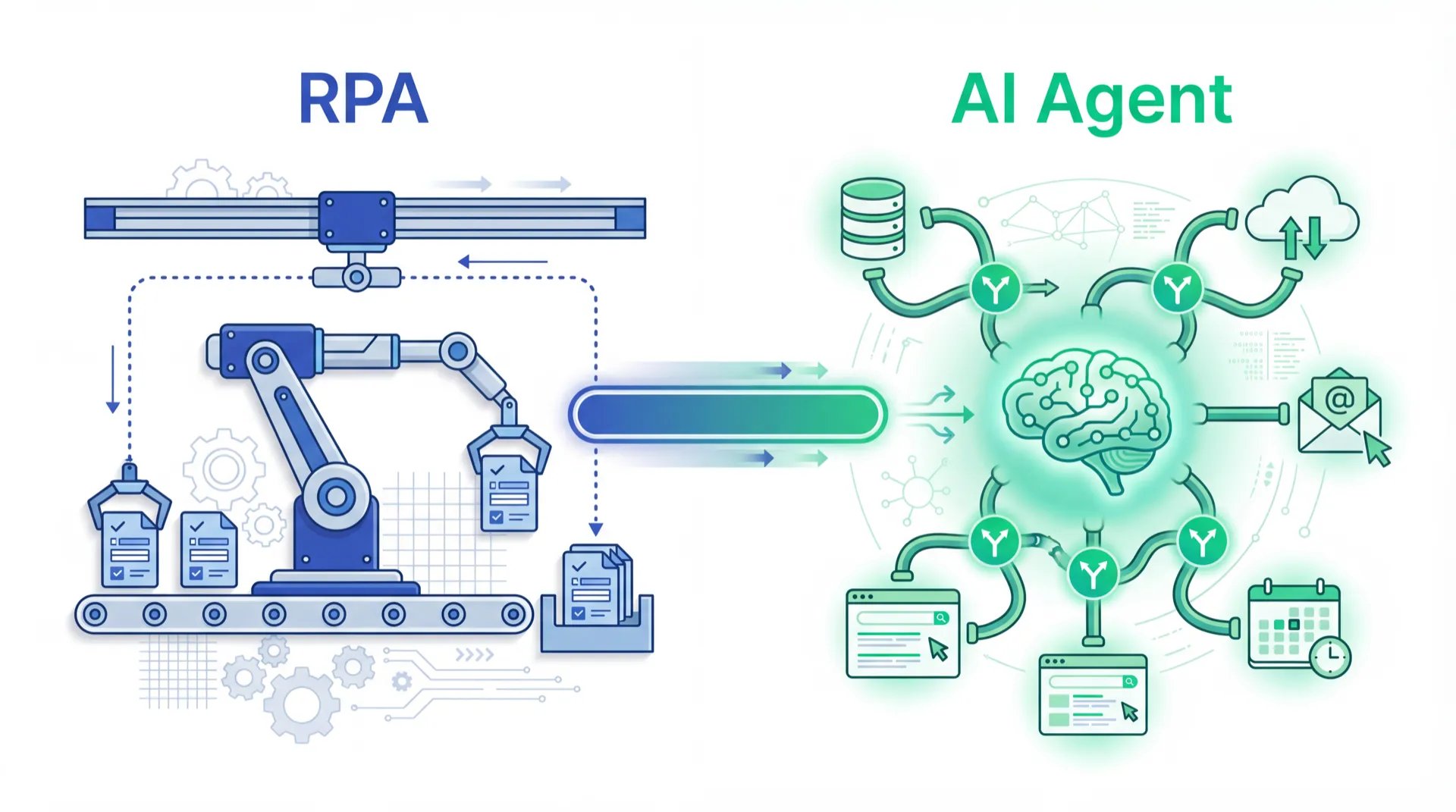
AI automated decision-making primarily involves using artificial intelligence (AI) assistants to automate decision processes, particularly when handling repetitive, rule-based tasks. This is typically achieved through combining Robotic Process Automation (RPA) and Business Process Management (BPM), aimed at simplifying business processes and improving decision-making. For example, intelligent automation systems can handle complex tasks with minimal human intervention, such as automated report generation, transaction processing, and compliance checks.
For instance, AI can analyze customer behavior and preferences to provide personalized product recommendations and marketing strategies, thereby improving customer satisfaction and sales. It can also predict market demand in supply chain management, optimize inventory management and logistics arrangements, reduce costs, and improve supply chain efficiency.
3. Emergence of Generative AI Agents
AI agents can be viewed as one of the most exciting business applications of generative AI in recent years. AI Agents are software systems or programs based on artificial intelligence (AI) assistants that can autonomously perceive environments, process information, and execute tasks. They possess human-like intelligent behavior and can learn, reason, decide, and interact through computation to autonomously complete specific tasks in dynamic or complex environments, reducing human intervention.
In terms of applications, generative AI can automatically write marketing copy, design advertising materials, helping marketing teams quickly produce high-quality content and improve brand exposure. It can also provide innovative concepts in product design, accelerating communication processes, shortening development schedules, and improving product competitiveness.
4. More Socially Responsible and Secure AI Applications
While artificial intelligence (AI) assistants develop rapidly, enterprises also need to promote their application with a responsible attitude to balance innovation and ethical needs. AI development should follow rigorous ethical standards, avoiding excessive pursuit of short-term profits while neglecting intellectual property rights or ethical issues, which could lead to user trust crises or even legal and regulatory risks. Therefore, enterprises need to incorporate social responsibility into their core values, establishing long-term trust foundations with the public and making AI technology applications more sustainable.
Additionally, because the combination of AI and cybersecurity is becoming an important means for enterprises to address digital threats, enterprises should establish continuous threat exposure management programs, regularly review response measures, implement MFA (Multi-Factor Authentication) requiring users to undergo multiple verifications to strengthen identity authentication, or ZTNA (Zero Trust Network Access) through encrypted tunnels and fine access controls to ensure appropriate professionals, processes, and technologies to manage risks.
As technology advances, AI assistants and tools are becoming more flexible, intelligent, and autonomous, not only bringing convenience to life and business but also injecting innovative vitality into healthcare, education, and other fields. They will continue to profoundly transform human society in the future.
Seven Major AI Tool Application Areas
Facing the dazzling array of AI tools in the market, how should enterprises choose solutions that fit their needs and fully unleash their potential during application? Below are seven major AI assistant tool trends for reference:
1. Intelligent Customer Service Systems
AI assistants are widely applied in customer service, providing real-time, accurate customer support. Through natural language processing technology, AI assistants can understand and respond to customer inquiries, solve common problems, and reduce labor burden. Additionally, AI assistants can operate 24/7, improving customer satisfaction. For example, many enterprises have deployed AI chatbots to handle customer service needs and improve service efficiency.
2. Business Process Automation
AI assistants play important roles in business process automation. Through machine learning and data analysis, AI assistants can automatically execute repetitive tasks such as data entry, report generation, reducing error rates and saving time. This allows employees to focus on more creative work, improving overall productivity.
3. Marketing and Data Analytics
In marketing, AI assistants can help enterprises analyze large amounts of data, gain consumer behavior insights, and formulate precise marketing strategies. Through AI technology, enterprises can predict market trends, optimize ad placement, and improve return on investment. For example, AI assistants can analyze social media data to understand brand reputation and provide improvement suggestions.
4. Human Resource Management
AI assistants play important roles in talent recruitment, employee training, and performance evaluation. Through AI technology, enterprises can screen candidate resumes, match suitable positions, and improve recruitment efficiency. Additionally, AI assistants can help develop personalized training plans, improve employee skills, and promote career development.
5. Supply Chain and Logistics Management
In supply chain and logistics, AI assistants help enterprises optimize inventory management, predict demand, and improve supply chain efficiency. Through AI technology, enterprises can monitor logistics status in real-time, predict potential problems, take action in advance, and reduce operational risks. This helps improve product delivery speed and enhance customer satisfaction.
6. Financial Analysis and Risk Management
AI assistants in finance departments are used for automated data processing and analysis, helping enterprises make wiser financial decisions. Through AI technology, enterprises can predict market changes, identify potential risks, and formulate corresponding response strategies. Additionally, AI assistants can help detect abnormal transactions, prevent financial fraud, and protect enterprise asset security.
7. Product R&D and Innovation
AI assistants drive innovation in product R&D. By analyzing market demand and technology trends, AI assistants help enterprises develop new products that meet market needs. Additionally, AI technology can be used for simulation and testing, shortening product development cycles and reducing R&D costs. This enables enterprises to bring innovative products to market faster and improve competitiveness.
In summary, AI assistant applications across various business domains are gradually becoming important tools for enterprises to enhance competitiveness. MaiAgent can help enterprises improve competitiveness in the AI era, achieve intelligent and automated business processes, improve efficiency, and create more value.
💡 To learn more about solutions MaiAgent can provide for your enterprise, please contact us directly through customer service assistant or email.