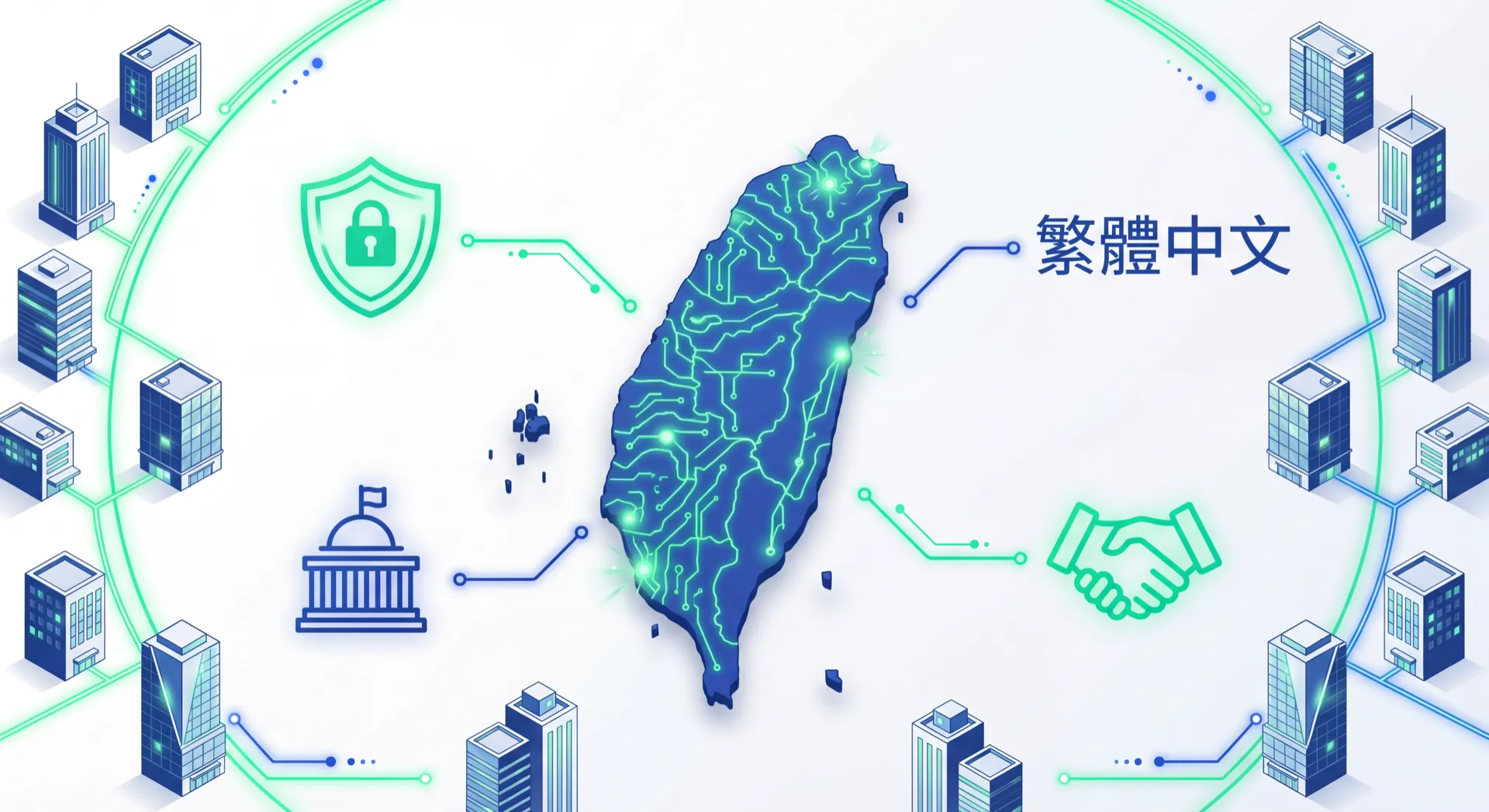
When evaluating AI platforms, Taiwan enterprises naturally look first at global names—OpenAI, Google, Microsoft, AWS. Strong brands, leading technology, comprehensive documentation—they seem like the safe choice. But after actual deployment, many enterprises discover the problem is not the technology itself but the gap between technology and the local environment. A local AI vendor means one that has a team in Taiwan, understands local regulations and linguistic context, and provides Chinese-language technical support and customized services. Choosing a local vendor is not because global players are inadequate—it is because AI deployment success often hinges on the last mile, and that mile requires someone to walk it with you.
Traditional Chinese Is More Than a Translation Problem
Large language models are trained primarily on English and Simplified Chinese; Traditional Chinese representation is relatively low. Taiwan-LLM research from NTU found that open-source models perform significantly worse on Traditional Chinese (zh-tw) than Simplified Chinese (zh-cn)—not just due to character differences, but divergence in vocabulary, neologisms, and expression habits since the 1950s. In practice: when a customer asks "does this plan include tax?", the AI needs to understand Taiwanese business context. When an employee queries "Labor Standards Act overtime limits," the AI must cite Taiwan law, not mainland China's. That localization cannot be solved by layering translation on top of a global model.
Data Sovereignty Is Not Optional—It Is the Floor
Taiwan's PDPA amendments in November 2025 further aligned with EU GDPR standards, strengthening data sovereignty protections. In specific industries the restrictions are stricter: the FSC's 2024 AI Guidelines for financial institutions require governance, accountability, privacy, and security throughout the entire AI deployment lifecycle. NCC prohibits telecoms from transferring user data to mainland China; health and labor agencies have followed with similar restrictions. These regulations mean your AI platform must answer not just "can we technically do this?" but "do regulations permit it?"
After-Sales Support Is Not a Hotline—It Is the Key to Deployment Success
Enterprise AI deployment does not end when you buy the software. Knowledge bases need to be built, tuned, and continuously updated. User feedback needs to be collected, analyzed, and converted into improvements. IDC research identifies the top two barriers to AI adoption in Asia Pacific as "lack of skills and knowledge" (23%) and "solution cost too high" (23%). Local vendors can train your team in your language, price flexibly based on your actual usage, and operate in your time zone. MSI's EZ PC Builder with MaiAgent went from requirements discussion to launch in just a few weeks because both teams could communicate in real time and iterate fast.
Taiwan Is Building Its Own AI Sovereignty
In 2025, the Taiwan government launched "Ten Major AI Infrastructure Projects," committing over $30.8 billion with a target of helping 200,000 enterprises complete AI transformation by 2028. GMI Cloud built Taiwan's first AI Factory with 7,000 NVIDIA Blackwell GPUs. The signal is clear: Taiwan intends to be not just an AI chip manufacturer but an AI application hub. For enterprises, the local AI ecosystem is maturing fast—from compute infrastructure to application-layer vendors, with more choices and higher quality.
Three Questions to Ask Before You Start
Can your data leave Taiwan? If you are in a regulated industry—financial, medical, telecom—the answer may be "no" or "conditionally." You need not just a vendor capable of on-premise deployment, but an advisor who understands Taiwan's regulatory boundaries.
Are your users comfortable with Traditional Chinese? If your AI Agent serves Taiwan customers or employees, Traditional Chinese comprehension is not a bonus—it is table stakes.
Who will help you optimize after go-live? AI is not a set-and-forget system. Knowledge bases expire, business changes, user needs evolve. You need a team that can run alongside you for the long term.
FAQ
Can local AI vendors match global players technically?
Local vendors do not need to train foundation models themselves. MaiAgent's platform supports multi-model switching—using OpenAI, Anthropic, Google, and other top global models—while providing localized services at the application layer for knowledge base construction, prompt tuning, and system integration. Best global model at the base, best local expertise at the top: that is the most pragmatic combination.
Will choosing a local vendor lock us in?
A good local vendor actually helps you avoid lock-in. MaiAgent's architecture supports multi-model strategies and standardized MCP / Agent Skills integration without binding to any single model provider. Your knowledge base and Skills accumulate within your organization—switching models does not require starting over.
Which Taiwan industries need local AI vendors most?
Financial services (FSC AI guideline compliance), healthcare (medical records and personal data protection), manufacturing (on-site SOP localization), and government agencies (data must stay in Taiwan) are the most obvious four. But any enterprise whose AI handles Traditional Chinese, serves Taiwan users, or touches Taiwan regulations will see clear value from a local partner.