Your company has probably already held at least one "AI strategy meeting."
Maybe vendors have come in to pitch. Maybe you've run a proof of concept. Maybe employees are already using ChatGPT for day-to-day tasks. But every time you try to move forward, you get stuck — not on the technology, but on the harder question: Are we actually ready?
Gartner's 2026 research shows 65% of enterprises are now in full AI pilots. Yet according to Master of Code, only 5% see real, measurable ROI from their AI investments. Deloitte documented an even more sobering number: 46% of AI proof-of-concept initiatives are scrapped before reaching production.
The gap isn't model quality. It isn't the vendor. It's readiness — whether the foundational conditions for AI adoption are in place before deployment begins.
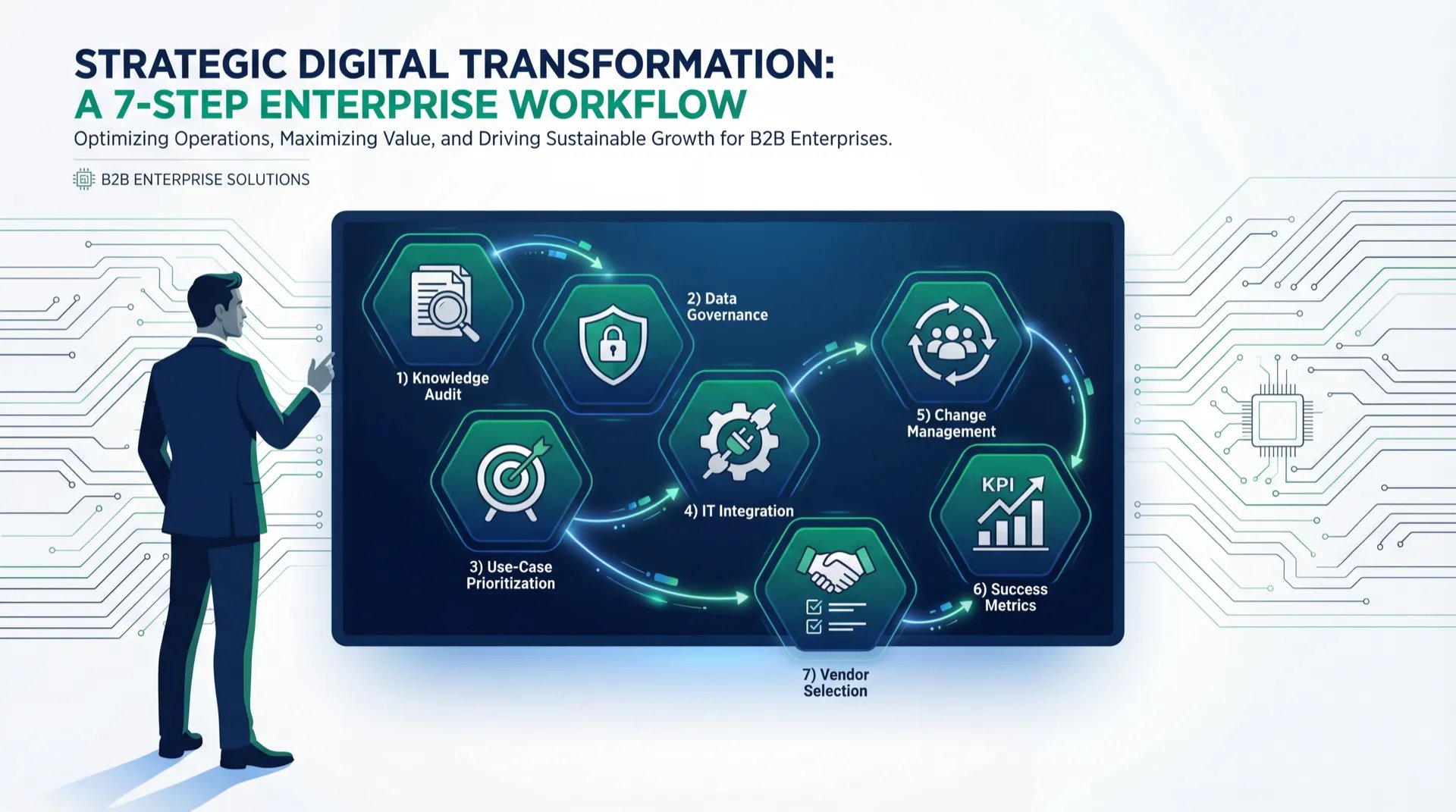
These are the seven dimensions I work through in every enterprise AI engagement. Miss any one of them, and problems will surface downstream — usually at the worst possible moment.
1. Knowledge Audit: Does Your AI Have Anything Worth Knowing?
An AI assistant is only as useful as the knowledge you give it.
MIT Sloan estimates that 60–80% of critical enterprise knowledge lives in employees' heads — not in documents or systems. This includes things like: a long-standing client's custom pricing logic, informal SOPs that have never been written down, exception-handling that experienced managers do by instinct.
Without systematizing that knowledge first, your AI can only answer the most basic questions and will disappoint users the moment a real-world edge case appears.
Questions to assess now:
What percentage of your existing documents are current and actively maintained?
Which departments have critical knowledge concentrated in a handful of people?
Are documents stored in structured repositories, or scattered across email attachments and chat threads?
Not having complete documentation doesn't mean you can't start — but you need to know the gap exists and build knowledge capture into the project plan. If you skip this step, you'll deploy a platform, go live, and then hear employees say "it can't answer anything we actually need to ask." That failure is more damaging to organizational AI confidence than not deploying at all. See how MaiAgent's AI knowledge management solution approaches this systematically.
2. Data Governance: Who Gets to Decide What the AI Can Access?
Data governance isn't primarily a security or IT architecture question. In large enterprises, it's a political problem that determines whether AI deployment can move at all.
A seemingly simple question like "can this contract data be used in the internal AI knowledge base?" may require sign-off from legal, sales, IT, and information security — each with different concerns, different timelines, and different approval processes. Without a clear data ownership structure, every piece of content becomes a case-by-case negotiation, and deployment grinds to a halt.
What to confirm before you start:
Does every data type (customer records, contracts, internal reports, technical documentation) have a designated data owner?
Is a data classification framework in place — what's public, what's restricted, what's confidential?
Is there a lightweight process for business units to request "this content can enter the knowledge base"?
If the answer to any of these is no, consider running a focused data governance workshop before any AI procurement begins. Two to four weeks upfront saves enormous time downstream.
3. Use Case Prioritization: Not Every Problem Deserves an AI Solution
The most common mistake in early AI adoption is trying to solve everything at once. The result: every use case gets partial attention, nothing gets done properly.
Use a simple 2×2 matrix to prioritize:
High Frequency × High Business Value: First priority — deploy now
Low Frequency × High Business Value: Second priority — evaluate ROI
High Frequency × Low Business Value: Third priority — automate for efficiency
Low Frequency × Low Business Value: Deprioritize
The internal vs. external distinction matters equally. Internal AI assistants — employee Q&A, onboarding, knowledge management — carry lower risk, are more controllable, and allow faster iteration. Customer-facing AI — chatbots, LINE service — directly affects customer experience and requires higher accuracy standards and more robust error handling. Start internal. Prove the model. Then expand outward.
Find one use case in the "high frequency × high value × internal" quadrant. Build it right. Then scale. Explore MaiAgent's enterprise solutions for detailed scenario planning frameworks.
4. IT Integration Inventory: Which Systems Must the AI Connect To?
This is consistently the most underestimated dimension of any technical assessment.
When a business unit says "we want an AI assistant that can answer questions about order status," the IT implications cascade immediately: Does it connect to the ERP? Is there a REST API or only direct database access? Is there a test environment? Where's the API documentation? Who has permission to open a test account?
Mapping integration dependencies early prevents the most demoralizing kind of delay: discovering mid-deployment that a critical system requires a three-month procurement process just to enable API access.
A practical integration checklist:
Communication channels: LINE, Microsoft Teams, Email, WebChat
Business systems: CRM (customer lookups), ERP (orders, inventory)
Document repositories: SharePoint, Google Drive, Confluence, internal wikis
Identity and access: SSO, Active Directory / LDAP (determines who can access what AI functionality)
For each system, capture three data points: is integration required, is an API available, and what's the realistic enablement timeline. MaiAgent's Agent DevKit provides a standardized integration framework that substantially reduces the time from this checklist to live deployment.
5. Change Management: Do Department Heads Actually Support This?
McKinsey research attributes 40% of AI project failures to change management issues — not technical failures.
I've watched technically excellent AI deployments quietly die within six months because a single influential department head was passively resistant. Not openly opposed — just not engaged, not promoting adoption, not resolving blockers when they emerged. The reasons are usually human and understandable: concern about losing departmental influence, anxiety about KPI redefinition, worry that AI monitoring will change how their team is evaluated.
Signals to check before deployment:
Have department heads been included in requirements interviews, or only informed of decisions already made?
Is there a clear and consistent internal narrative that AI augments people rather than replacing them?
Is the IT department an active champion or a reluctant executor? Enthusiastic IT teams are one of the strongest predictors of successful deployment.
If a key stakeholder is lukewarm, don't force the rollout in their domain. Take time to understand their specific concerns, identify a concrete problem AI can solve for them, and convert a potential blocker into an internal advocate.
6. Define Success Metrics Before Deployment, Not After
"Deploy first, measure later" is one of the most common and costly AI adoption mistakes.
Without a baseline, you cannot tell whether the AI is working. You cannot build the business case for continued investment. And when a senior executive asks in a quarterly review "what's the ROI on our AI initiative?" — you have no answer ready.
Recommended KPIs by use case:
Customer service AI: Deflection rate, average response time, CSAT score
Internal knowledge Q&A: Employee query resolution rate, AI utilization rate, reduction in manual search time
Sales assistance: Quote preparation time, proposal cycle time reduction
Before defining KPIs, measure current-state baselines. How long does it take today to respond to a typical customer inquiry? How many minutes does an employee spend finding a standard procedure document? Baselines make outcomes legible. Without them, AI success is an opinion. With them, it's a fact.
7. Vendor Selection Criteria: Beyond the Feature Checklist
The final dimension is vendor evaluation — and it's often approached the most casually. Three criteria matter far more than feature lists:
Cloud vs. on-premise deployment: If your data includes personal information, trade secrets, or legally regulated content, data residency is a hard requirement, not a preference. Confirm whether the vendor supports private deployment or hosting within Taiwan's infrastructure before anything else in the evaluation.
Language depth, not just language support: Handling Traditional Chinese conversationally is table stakes. What matters is the depth of localization — does the vendor's RAG pipeline include language-specific tokenization optimizations for Traditional Chinese? Test it with your actual documents and your team's real questions, not vendor-curated demos.
Local technical support: AI deployment is an ongoing optimization process, not a one-time installation. Does the vendor have technical staff in your timezone who respond quickly when unexpected behavior occurs in production? When your AI assistant gives a wrong answer to a customer, how fast can the vendor help you diagnose and fix it?
Platform extensibility: Your first use case will succeed, and you'll want to expand. Can the vendor's platform support multiple agents and cross-department deployments without rebuilding from scratch each time? Evaluate the MaiAgent enterprise solution portfolio for an example of what enterprise-grade extensibility looks like in practice.
This Is an Organizational Conversation, Not a Solo Checklist
None of these seven dimensions can be assessed by one person working alone.
Knowledge audit requires department head cooperation. Data governance requires legal and IT input. Use case prioritization requires cross-functional business context. Change management requires C-level visibility. AI readiness assessment is fundamentally a cross-functional organizational conversation.
The good news is that this conversation has value even if you decide not to deploy anything. It forces organizations to surface assumptions and disagreements that have been operating quietly in the background — and often reveals process problems that don't require AI to fix.
At MaiAgent, we've structured this conversation into a focused 60-minute AI readiness session, walking enterprise teams through all seven dimensions systematically before any purchasing decision is made. The output is a prioritized action roadmap specific to your organization's current state.
Want a structured assessment of your enterprise's AI readiness? Book a free 60-minute AI readiness session →
Frequently Asked Questions
Our employees are already using ChatGPT. Does that mean we're ready?
Employees self-adopting ChatGPT and enterprise-grade AI deployment are fundamentally different initiatives. The former is an individual productivity tool; the latter involves data governance, system integration, user management, and compliance requirements. Organic ChatGPT adoption is actually a signal that genuine demand exists — but it also suggests potential "shadow AI" risk, where employees may be pasting sensitive company data into unmanaged external services. If you're observing this pattern, it's a stronger reason to accelerate a properly governed enterprise AI deployment, not a reason to delay.
Do all seven factors need to be fully addressed before starting?
No — and no enterprise has perfect scores across all seven dimensions before deployment. What matters is knowing your current-state score on each dimension and understanding which gaps are "must-resolve before launch" versus "can be improved iteratively post-launch." Knowledge audit and data governance typically fall in the first category. Integration completeness can usually be phased.
What if a key department head is resistant?
Start with the champions, not the skeptics. Select your first use case in a department where leadership is genuinely engaged and supportive. Demonstrated results are the most powerful tool for changing resistant attitudes — when a skeptical leader watches a peer department reduce customer response time by 60% using AI, the resistance tends to soften on its own. Picking the right first use case and making it visibly successful is the most effective change management strategy available.
How does MaiAgent's readiness assessment differ from doing it ourselves?
Internal assessments tend to be superficial because people inside an organization find it genuinely difficult to identify their own blind spots. External facilitation brings three things: structured questions that surface what's typically glossed over, a neutral perspective unconstrained by internal politics, and cross-industry benchmarks from deployments across manufacturing, financial services, retail, and healthcare. Learn more at MaiAgent enterprise solutions or reach out directly.
References
Gartner: AI Adoption Trends 2026 — 65% of Enterprises in Full Pilots
Master of Code: Enterprise AI ROI Report — Only 5% Achieve Measurable Returns
Deloitte: State of AI in the Enterprise 2026 — 46% of POCs Scrapped Before Production
McKinsey: The State of AI 2025 — 40% of AI Projects Fail Due to Change Management
MIT Sloan Management Review: Why Knowledge Management Still Matters