When enterprises decide to implement an AI Agent, the first questions are usually technical: which model to use, how to build the knowledge base, how to integrate with existing systems.
But there's a more fundamental question worth answering first: Who is this Agent for?
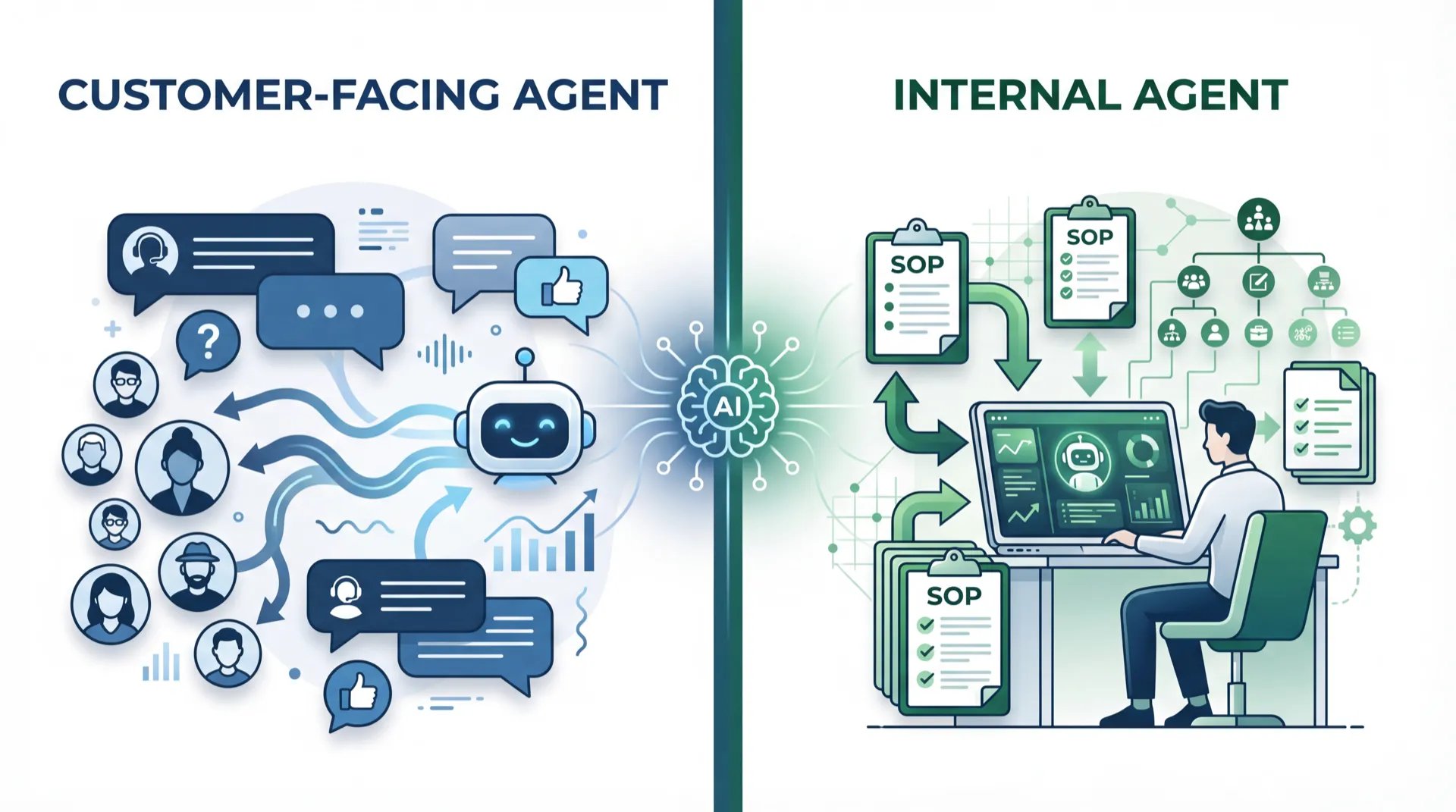
A Customer-Facing Agent (External Agent) interacts directly with customers — handling product inquiries, guiding purchase decisions, and providing after-sales support. An Internal Agent serves employees — helping them look up SOPs, search internal knowledge bases, and support complex decision-making. Both rely on a knowledge base and share similar technical architecture, but their goals, success metrics, owners, and knowledge content are completely different.
Many enterprises skip this step during implementation, resulting in systems that can't clearly articulate what problem they solve. MIT Sloan Management Review research found that 95% of enterprise AI projects fail to produce measurable bottom-line impact — and the lack of a clear problem definition is often where failure begins.
Customer-Facing Agents: Serving Your Customers
The customer-facing AI Agent's mission is to interact directly with customers — answering product questions, guiding purchase decisions, providing after-sales support, and handling inquiries. It represents your brand, and every response is a customer touchpoint.
The MSI EZ PC Builder, built with MaiAgent, is a classic example. Customers tell it their budget and requirements, and the AI assistant recommends the best component combinations based on MSI's full product knowledge base — globally available and multilingual. This type of Agent delivers core value by letting customers receive expert recommendations without a sales rep, lowering purchase barriers and increasing conversion rates.
Customer-facing Agents aren't limited to text chat. A restaurant chain deployed a voice AI to automatically handle reservation and delivery calls during peak hours, freeing staff to focus on in-store service. A city government deployed a unified intelligent service portal that integrates information across departments — citizens no longer need to make multiple calls to different offices.
Industry | Use Case | Core Value |
|---|---|---|
Consumer Electronics | AI product selector (MSI EZ PC Builder) | Lower purchase barrier, increase conversion |
Airlines | Text-based customer service Agent | 24/7 handling of passenger inquiries |
Sports Brands | AI running coach Agent | Personalized training advice, deepen brand engagement |
Restaurant Chains | Phone voice assistant | Auto-handle reservations and delivery, free staff |
Brand Marketing | Campaign Agent | Interactive brand experience, boost event participation |
Parking | Phone voice assistant | Real-time space availability and rate inquiries |
City Government | Unified smart citizen service | Cross-department info integration, single portal |
Success metrics for customer-facing Agents revolve around customer experience and business outcomes — issue resolution rate, conversation-to-purchase conversion, CSAT, and the degree to which they augment or replace customer service headcount.
The knowledge base behind a customer-facing Agent contains "what you want customers to know" — product specs, FAQs, recommendation logic, after-sales policy. It needs to be precise, because customers won't give you a chance to explain "the AI is still learning."
Internal Agents: Serving Your Employees
The internal AI Agent's mission is to help employees work more efficiently — querying internal policies, finding SOPs, locating correct answers in large document repositories, and supporting complex decisions.
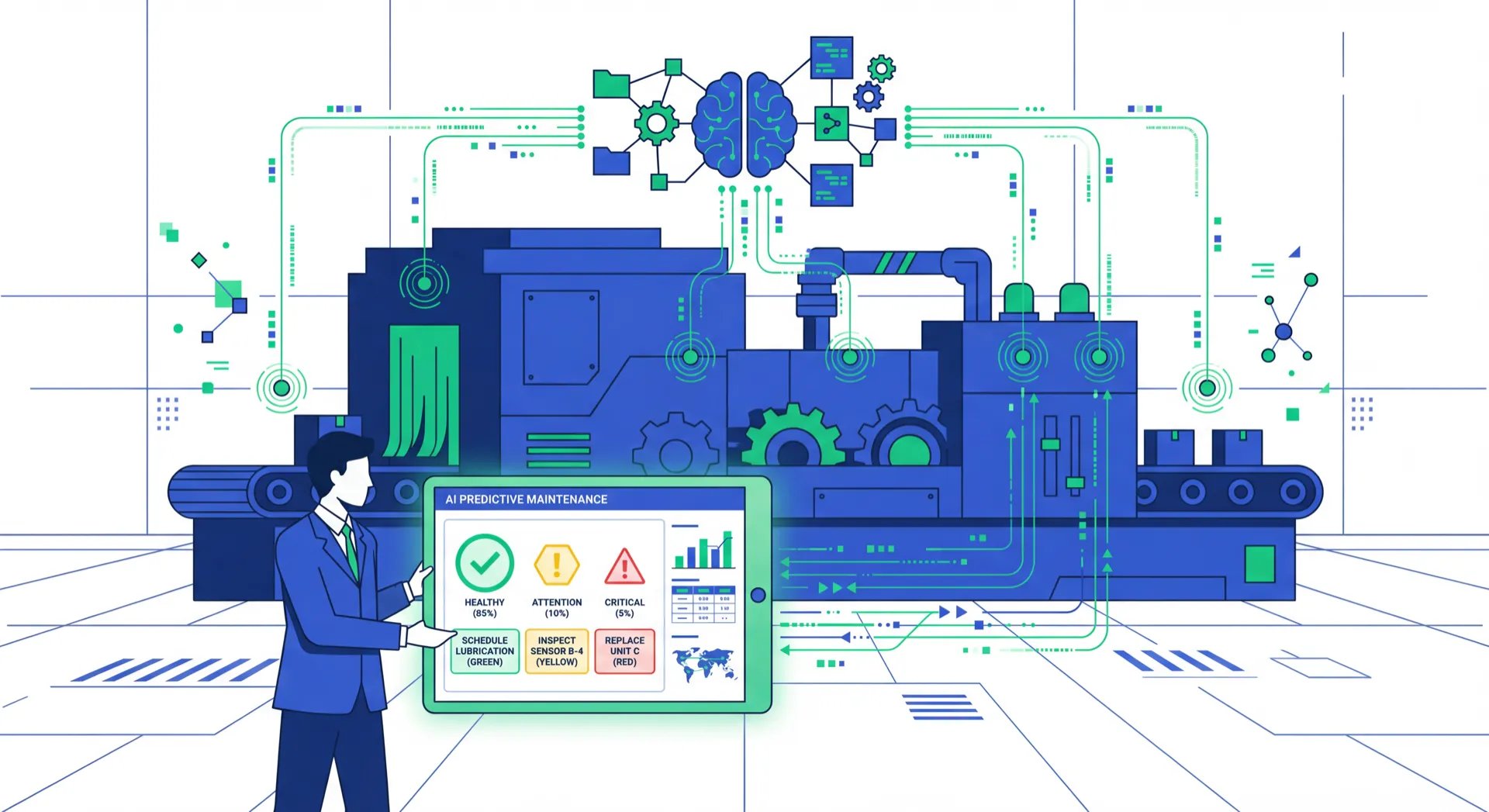
In MaiAgent's manufacturing deployment with Advantech, factory engineers can query equipment maintenance SOPs via smartphone — no more flipping through manuals or waiting for a senior technician. Issue resolution time dropped by 70%, with user satisfaction exceeding 90%. A commercial bank with over NT$1 trillion in assets deployed an AI Copilot for hundreds of customer service reps to query complex financial product terms and interest rate rules in real time during calls — query time also cut by 70%.
Industry | Use Case | Core Value |
|---|---|---|
Manufacturing | Equipment operation & maintenance SOP AI assistant | On-site real-time query, reduce resolution time |
Banking | Customer service Copilot | Real-time financial product lookup during calls |
Healthcare | ICD-10 coding AI assistant | Accelerate medical coding, improve consistency |
Electronics Brand | Dealer product knowledge Q&A | Instant product spec access across dealer network |
Public Sector | Internal knowledge management (KM) system | Unified portal for cross-department policies and SOPs |
Enterprise Universal | Gen BI chart analysis Agent | Natural language queries, auto-generate data charts |
Success metrics for internal Agents revolve around productivity and adoption — how many employees actually use it, how much query time is reduced, whether escalation rates decrease, and how employees rate answer accuracy.
The knowledge base behind an internal Agent contains "information employees need to do their jobs" — internal SOPs, product manuals, regulatory requirements, historical cases, decision rationale. The core challenge isn't precision, it's completeness and timely updates. An outdated SOP can be more dangerous than no SOP, because employees assume they have the correct version.
Why Planning Them Together Creates Problems
Both Agent types look similar on the surface — both use RAG, both use large language models, both have chat interfaces. But when a customer-facing Agent fails, you lose customers. When an internal Agent fails, you waste budget and internal trust capital. Once that trust erodes, every future AI initiative becomes harder to push through.
Three Questions to Answer Before You Build
1. Is the problem you're solving customer-side or employee-side?
Customers frequently can't find product information, repeat the same questions, or hesitate before purchasing — that's the customer-facing Agent scenario. Employees spend too long finding the right SOP, senior staff leaving takes institutional knowledge with them, new hires ramp up slowly — that's the internal Agent scenario.
Often both problems exist. The recommendation: pick one first, complete it, validate it works, then tackle the second. Pursuing both simultaneously scatters resources and makes measuring impact nearly impossible. Build one success story, get the data, then make the case for the next one — you'll move faster overall.
2. Can users tolerate occasional errors?
Employees know it's a new tool, they'll report errors — that's an environment for continuous improvement. Customers won't. A wrong answer might mean a lost customer or a negative review. This difference in error tolerance determines how long your preparation period needs to be, and how complete your knowledge base must be before launch.
3. Who defines success?
Customer-facing Agent outcomes are directly tied to business goals and should be owned by Sales or Marketing, with IT executing. When IT owns it, "system stability" easily becomes the definition of success rather than "customer issue resolution rate." Internal Agents should be owned by whoever understands employee workflows best — a department head or process designer. Different owners lead to completely different knowledge base priorities and acceptance criteria.
Common Mistakes
Applying customer-facing acceptance criteria to internal Agents
Customer-facing Agents demand high precision because one wrong answer can cost you a customer. Applying the same standard to internal Agents often means you never launch — waiting for a perfect knowledge base means employees keep using their old methods, and switching them later becomes even harder. A better strategy: launch at 80% completeness, collect feedback, iterate fast. Let employees co-build the knowledge base — it accelerates adoption.
Launching a customer-facing Agent with an incomplete knowledge base
Business pressure creates urgency, but launching before the knowledge base is ready means customers hit uncovered questions — the AI starts making things up or drawing blanks, damaging your brand. And that damage is cumulative; customer trust, once lost, is hard to rebuild. Before launch, run at least a pressure test on the Top 50 most common customer questions and confirm the AI answers them correctly.
Pushing both Agent types on the same team with the same timeline
Customer-facing Agent launch pace is constrained by knowledge base completeness and brand risk assessment. Internal Agent launch pace is constrained by employee adoption willingness and process integration. These rhythms are inherently different. Forcing synchronization typically results in both projects delayed — the external one because precision isn't ready, the internal one because resources were diverted.
Frequently Asked Questions
Can internal and external Agents share the same knowledge base?
Sharing directly is not recommended, but they can share the underlying technical infrastructure. External knowledge bases need strict review — every piece of information must be safe and accurate for customers. Internal knowledge bases need comprehensive internal information, including content not suitable for public exposure (internal pricing rules, HR policies, etc.). In practice: build separate knowledge bases, share the RAG retrieval engine and model infrastructure.
Which is easier to implement — internal or external?
Internal Agents are generally easier to succeed with, because users (employees) have higher error tolerance, feedback loops are tighter, and iteration is faster. External Agents have a higher preparation bar, but successful external Agents have more directly visible business impact.
Can you run internal and external Agent projects simultaneously?
Yes, but they require separate teams, budgets, and acceptance criteria. If resources are limited, complete one first and validate its impact — running both simultaneously often leaves both stuck as half-finished products.
With limited budget, which should come first — external or internal?
Follow your most urgent pain point. If customer churn or customer service costs are your biggest immediate problem, go external first — the impact shows directly in revenue, making it easier to secure further budget. If employee efficiency is low, knowledge transfer is fragmented, or new hire ramp-up is slow, go internal first — larger error tolerance, faster iteration, and you build internal confidence more quickly.
Before deploying an AI Agent, get clear on whether you're solving a problem outside your organization or inside it. Once the direction is clear, the answers to what knowledge to collect, how to measure success, and who should lead become obvious. Start building without that clarity and you typically end up with technical success and business failure.
MaiAgent helps enterprises start from "getting that clarity" — defining internal vs external, setting success metrics, auditing knowledge bases, then moving to technical implementation. From aerospace to food service, manufacturing to finance, healthcare to public sector, MaiAgent supports both internal knowledge management (AI KM) and external intelligent customer service. Not sure where to start? Bring your use case and let's talk.
Sources
MaiAgent x Advantech — One-Stop AI Solution for Manufacturing (-70% resolution time, 90%+ satisfaction)
MIT Sloan Management Review — Expanding AI's Impact With Organizational Learning (95% of enterprise AI projects fail to produce measurable impact)