"Is this AI project worth the investment?"
That's probably the question every CIO hears from their CEO before launching an AI initiative — and it's also the hardest question to answer. Not because the answer is no, but because most organizations simply don't have a coherent framework for doing the math.
MIT research found that 95% of enterprise AI projects fail to produce measurable bottom-line impact. Gartner predicts that by the end of 2025, 30% of generative AI projects will be abandoned after the proof-of-concept phase. Those numbers sound alarming — but look closer, and the cause of failure is rarely a technology problem. It's that no one defined what "success" looked like from the start.
Traditional IT ROI is straightforward: how much did we spend, how much labor did we save, when do we break even? ERP deployments can be modeled. CRM rollouts can be modeled. They replace well-defined processes and eliminate calculable time.
AI is different. A significant portion of AI's value is soft — improved decision quality, higher employee satisfaction, better customer experience, more efficient knowledge transfer. These benefits are real; they're just not easy to convert directly into dollar figures.
McKinsey's State of AI 2025 report shows that 78% of enterprises have adopted AI in some form, yet only 17% can report a 5%+ impact on EBIT. In other words, most companies have spent the money and done the work — but can't clearly articulate what they got back.
The problem isn't that AI lacks value. The problem is that the way we measure value hasn't kept up.
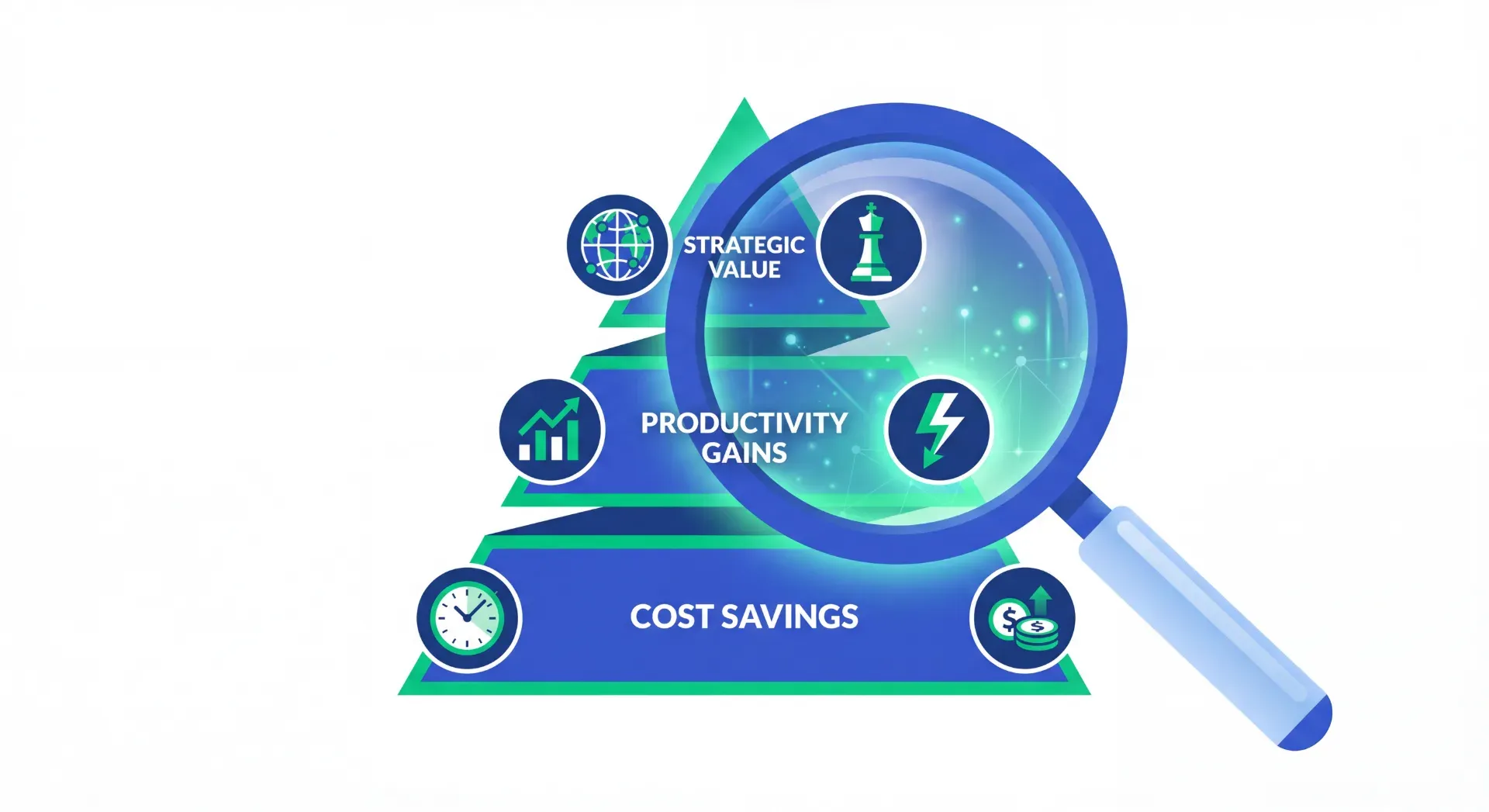
A Three-Layer ROI Framework
What enterprises need isn't a more complex financial model — they need a framework that captures AI's value across different dimensions. Here's a practical three-layer structure that works in the real world.
Layer 1: Quantifiable Direct Benefits
This is the easiest layer to calculate, and the one leadership most wants to hear about. It has three core components.
Labor cost savings. How much work has AI taken over from humans? If an AI customer service agent handles 60% of routine inquiries, and your team has 10 agents at an average monthly salary of $1,500, the monthly labor savings are $900 — a number that compares directly to the AI platform's subscription fee. (For a deeper look at how AI Agents differ across internal vs. external use cases, see: Before Deploying an AI Agent, Think Through This First)
Time cost savings. How much time are employees no longer spending on searching for information, waiting for responses, or handling repetitive tasks? In MaiAgent's manufacturing deployments with Advantech, engineers reduced the time spent looking up equipment maintenance SOPs by 70%. If an engineer previously spent two hours per day on lookups, a 70% reduction saves 1.4 hours daily. Multiply that by headcount and working days — the annualized impact is substantial.
Error cost avoidance. How much loss has been prevented because AI provided more accurate, consistent information? This is especially visible in manufacturing and financial services, where a single equipment misdiagnosis or compliance oversight can cost millions.
Layer 2: Indirect Benefits from Productivity Gains
The numbers in this layer won't appear directly on your income statement — but their impact is just as real.
Output per employee. The same headcount handles more cases, serves more customers, completes more work. Gartner research indicates that organizations successfully deploying AI see an average productivity gain of 22.6%. This isn't about replacing people — it's about the same people doing significantly more.
Decision velocity. An analytical report that used to take two days to compile can now be drafted in minutes. In fast-moving markets, decision speed is a form of currency.
Knowledge continuity. When a senior employee leaves, they don't just take a position with them — they take years of experience. An AI knowledge base retains that expertise and compresses new-hire ramp time from three months to one. This is hard to assign a dollar value to, but any leader who's navigated a knowledge gap understands what it costs.
Layer 3: Strategic Value
This is the hardest layer to quantify and potentially the most important.
Your competitors are still answering customer questions manually. Your AI-powered support runs 24/7 in multiple languages. That gap won't show up in a quarterly report — but over time, it's the difference in market positioning. Your knowledge system enables new employees to resolve 80% of issues within their first week; your competitor needs three months. That's organizational resilience.
Strategic value isn't measured by "how much is it worth" — it's measured by "what do we lose if we don't have it."
A Real Calculation Example
Consider a 200-person company evaluating an AI knowledge management system.
Annual investment:
AI platform license + knowledge base setup + training = estimated $65,000 USD
Layer 1 direct benefits:
Customer service labor savings (replacing 2 FTEs handling routine inquiries): ~$36,000/year
Employee query time savings (200 employees × 30 min/day × 250 working days × $15/hr): ~$375,000/year
Layer 1 alone delivers approximately 6× the initial investment.
Layer 2 indirect benefits:
A conservative 15% productivity gain, 50% faster onboarding, improved decision velocity — together, these add an estimated $120,000–$250,000 in indirect annual value.
Layer 3 strategic benefits:
Improved customer retention, stronger brand trust, competitive differentiation — long-term compounding effects.
Global data shows that successful AI deployments return an average of $3.70 for every $1.00 invested. The operative word is successful — and success starts with knowing what you're measuring before you begin.
Why Your AI Project Can't Show an ROI
If your AI initiative can't demonstrate ROI, the problem usually comes down to one of three root causes.
1. No baseline was established. Before deploying AI, no one measured the current state. How long does it take an employee to find information today? How many support calls does the team handle per day? What's the error rate? Without a baseline, there's nothing to compare against after deployment. Many AI projects appear ineffective not because they lack impact, but because there's no "before" data.
2. You're measuring activity, not outcomes. "The system went live." "We've built 500 knowledge base articles." "We're seeing 3,000 monthly queries." These are activity metrics, not outcome metrics. The real questions: How much has first-contact resolution improved? What's the employee satisfaction score for information retrieval? How much has the escalation rate dropped?
3. Expectations are miscalibrated. AI doesn't deliver full ROI in the first month. Most enterprise AI investments have a payback period of 2 to 4 years — significantly longer than traditional IT projects' 7 to 12 months. Judging a multi-year investment at the six-month mark will almost always look disappointing. (For a look at how knowledge base architecture choices affect long-term ROI, see: RAG Isn't Enough Anymore: What Is Agentic RAG?)
Start Your ROI Assessment With These Five Questions
No complex model required. Answer these first:
What are the top three problems you're deploying AI to solve?
How much employee time does each problem consume today?
If AI resolves 60% of each problem, what's the annualized value of that time savings?
What is the total implementation cost (license + setup + training)?
Divide cost by savings — what's the estimated payback period?
This rough calculation isn't perfect. But it accomplishes the most important thing: it gets decision-makers and execution teams aligned around the same set of numbers.
MaiAgent works with clients during the AI evaluation phase to build this measurement framework from the ground up — from baseline assessment through benefit tracking — so that from day one, there's a clear definition of what success looks like.
Frequently Asked Questions
How long does it typically take to see ROI from an AI deployment?
Most enterprises see a full payback period of 2–4 years. However, Layer 1 direct benefits — labor savings and time reduction — are typically observable within 3 to 6 months of go-live. The key is to start with a use case where the value is clear, validate quickly, and expand from there.
Do small and mid-sized businesses need this full framework?
Not necessarily. SMEs can start with just Layer 1 — labor cost and time cost savings. If those two figures already exceed the implementation cost, that's sufficient basis for a decision.
What are the hidden costs of AI deployment?
The most commonly overlooked costs are: ongoing knowledge base maintenance (content needs regular updates), employee training and change management (getting people to actually use the system), and iterative system integration work. These won't appear on the initial quote — but they generate continuous spend.
What if the ROI calculation doesn't look favorable?
It depends on which layers you're measuring. If Layer 1 alone doesn't justify the investment, but Layer 2 and Layer 3 strategic value is high — for example, competitors are already doing this, or customers are starting to expect AI-powered service — then the risk of not acting may outweigh the cost of acting. ROI is an input to the decision, not the only input.