
Once a company adopts AI, the biggest variable in its AI costs is often not usage. It is the model it chose.
Take a single customer service question. Assume about 10,000 input tokens (the system prompt, knowledge base snippets and the customer's question) and 500 output tokens. At the rates of MaiAgent, an enterprise AI platform, answering it with GPT-6 Luna costs about 25 Credits. With GPT-6 Astra it costs about 2,475 Credits, a 100x difference.

For a company that answers tens of thousands of questions a month, that is a budget gap of two orders of magnitude. But more expensive does not mean better. Of the 45 text models available on MaiAgent that have a public capability score, 39 have another option that is cheaper and at least as capable.
You can also start with the video version, under 3 minutes long.
1. How are AI costs calculated? LLM pricing comes down to input and output
1. How LLM billing works
Large language models are billed by the token, with input and output priced separately. The Credits deducted for each model call are calculated as follows.
Credits = input tokens ÷ 1 million × input rate + output tokens ÷ 1 million × output rate
Take GPT-6 Luna. Its input rate is 1,980 Credits per million tokens and its output rate is 9,900 Credits. A customer service question with 10,000 input tokens and 500 output tokens comes to 19.8 plus 4.95, or about 25 Credits. The input and output rates for every model are published in Credits Billing System.
2. Three AI costs that are often underestimated
The formula is simple, but three costs are often underestimated.
Often-underestimated cost | Why |
|---|---|
Output costs more than input | For most models, the output rate is 5 times the input rate, so longer answers cost more. With thinking mode on, the tokens the model uses for internal reasoning are also billed as output. |
Context is resent every time | The system prompt, tool definitions, knowledge base snippets and chat history are resent on every call, and an agent resends them each time it calls a tool. In two weeks of platform data from October 2026, messages with more than 40,000 tokens of context made up only 23% of messages but used 62% of tokens. |
Search result reranking | If this feature is turned on for a knowledge base, each retrieval adds about 40 Credits, more than a single answer from a low-cost model. |
Still, the biggest factor in AI costs is which model you choose.
2. Comparing LLMs: a more expensive model is not always better
1. What is the efficient frontier?
The efficient frontier is made up of the models that are the most capable among all models costing the same or less. Any model that is not on the efficient frontier has a cheaper alternative that is at least as capable.
The chart below plots each model as a dot. The horizontal axis is the Credits cost of one answer, and the vertical axis is the Epoch AI Capabilities Index (ECI). The data is the same as in the scatter chart in the MaiAgent admin console.
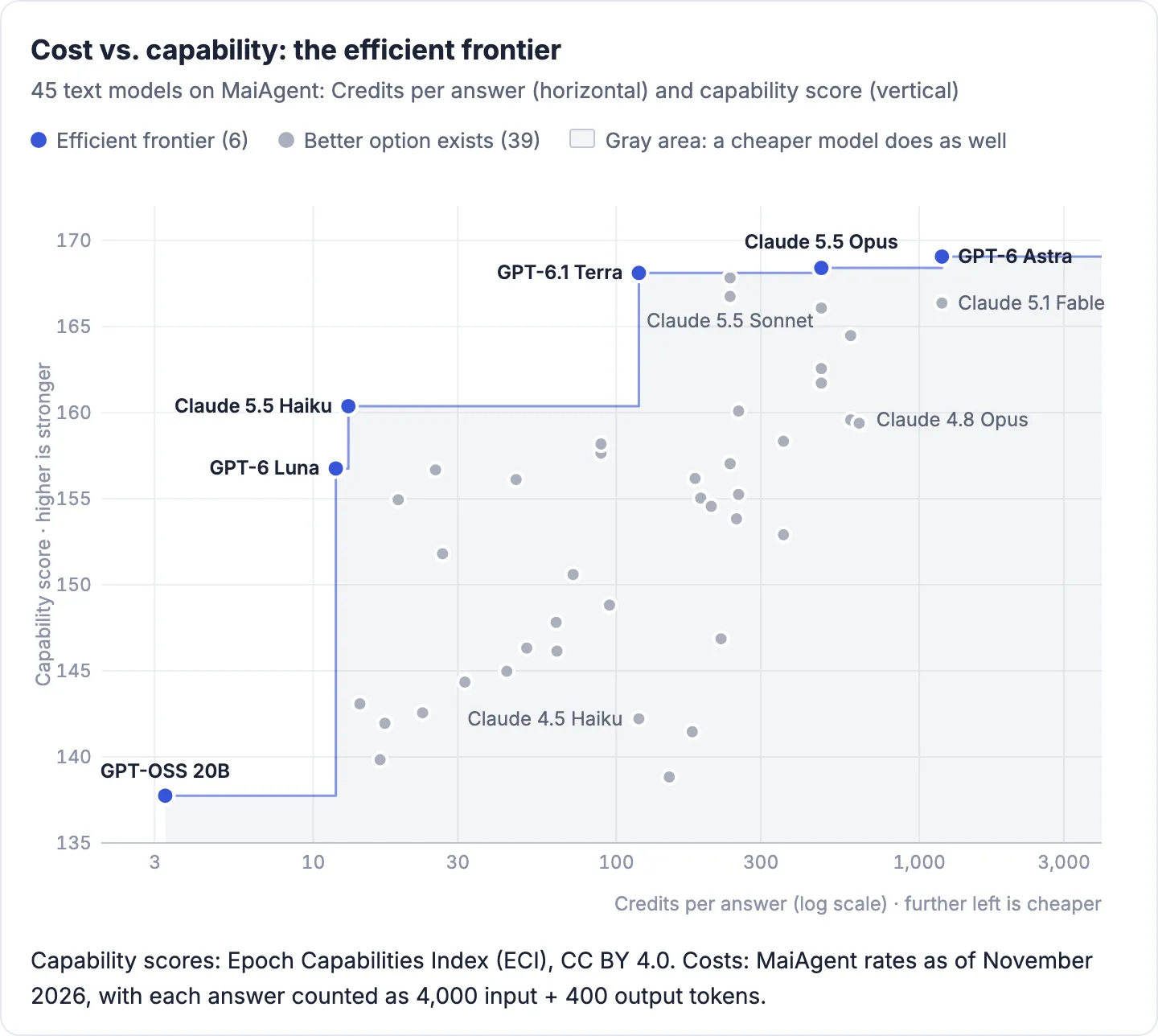
Of the 45 models, only 6 are on the efficient frontier. A few examples show that more expensive does not mean better.
GPT-6.1 Terra has a capability score of 168.1, just 0.3 points below Claude 5.5 Opus (168.4), at a quarter of the cost. It also costs half as much as Claude 5.5 Sonnet and GPT-6.1 Sol, and scores higher than both.
Claude 5.1 Fable costs 2.5 times as much as Claude 5.5 Opus, yet scores 2 points lower.
Claude 5.5 Haiku scores 160.4, already higher than Claude 4.8 Opus (159.6), the flagship model in May 2026, at 1/45 of its cost.
Model prices and capabilities change quickly, much faster than most companies update their settings.
2. The most cost-effective models today
Pick models by task difficulty, moving up a tier as tasks get harder, and in each tier choose a model on the efficient frontier. The table below uses November 2026 rates and assumes 10,000 input tokens and 500 output tokens per customer service question.
Model | Tier | Capability | Per customer service | Questions per | Good for |
|---|---|---|---|---|---|
GPT-6 Luna | Light | 156.8 | 25 | About 40,000 | High-volume customer service FAQs, summaries, classification |
Claude 5.5 Haiku | Light | 160.4 | 27 | About 37,000 | Same as above, with a higher score |
GPT-6.1 Terra | Mid-tier | 168.1 | 248 | About 4,000 | Multi-step tool calls, long-document analysis |
Claude 5.5 Opus | Flagship | 168.4 | 990 | About 1,000 | The hardest, highest-value tasks |
GPT-6 Astra | Flagship | 169.1 | 2,475 | About 400 | A small number of critical tasks |
With the Professional plan's 5 million Credits a month, using GPT-6 Luna for everything covers about 200,000 customer service questions, while using GPT-6 Astra for everything covers only about 2,000. The Enterprise plan's 10 million Credits a month doubles both numbers.
3. How can you lower AI costs? Start with tiers, then look for savings
1. Tier models by task difficulty
The most direct way to lower AI costs is tiering. Send high-volume questions with clear rules to light models, and use mid-tier or flagship models only for agents that need multi-step reasoning or work across systems. With the same Credits budget, a light model can answer dozens to 100 times as many questions as a flagship model.
2. Where you can still save after choosing a model
Once you have chosen a model, there is still room to save on that same model, for example by shortening the context resent on each call, making good use of prompt caching and adjusting the thinking effort.
To turn these savings into a return on investment, or to see how falling inference costs affect procurement strategy, read these two articles next.
Further reading: "How to Calculate AI ROI? A Framework Enterprises Can Actually Use" and "DeepSeek: Should Enterprises Rethink AI Procurement?"
4. AI cost calculator: run the numbers on your own usage
The table below lists the Credits each model uses per request in three common scenarios. Divide your monthly Credits allowance by the cost per request to see how many requests it covers in a month. For example, the Professional plan includes 5 million Credits a month, enough for about 200,000 customer service questions answered with GPT-6 Luna.
5. How fast are LLM prices falling? The same capability now costs hundreds of times less
1. Same capability, steadily falling prices
The trend is clearer if you hold the capability score fixed and look at what the cheapest model reaching that score cost at each point in time. The chart below converts each model's official launch price into Credits per question.
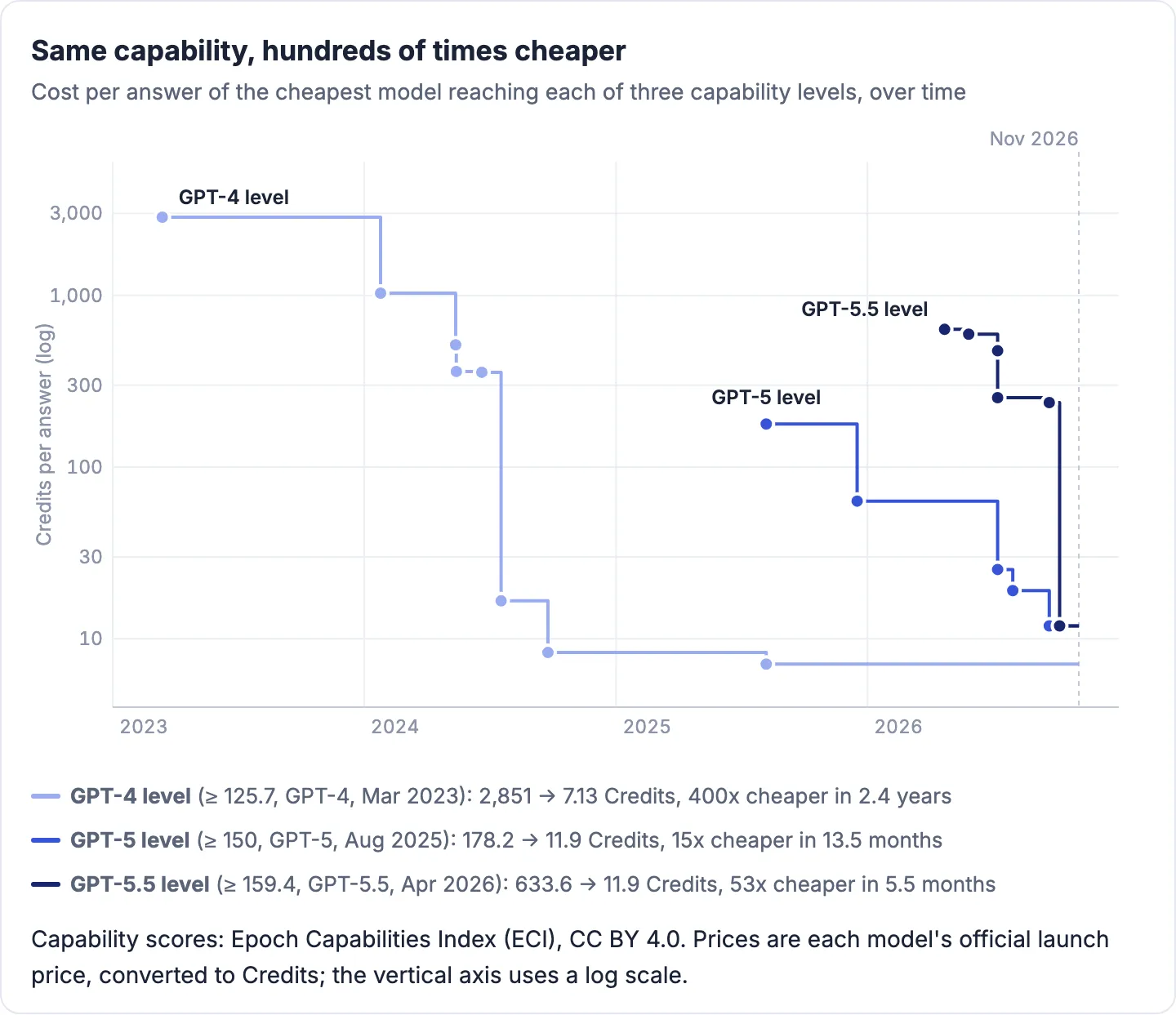
Capability level | Starting cost | Lowest cost (launch price) | Change |
|---|---|---|---|
GPT-4 level (≥ 125.7 points) | 2,851 Credits (GPT-4, Mar 2023) | 7.13 Credits | 400x cheaper in 2.4 years |
GPT-5 level (≥ 150 points) | 178.2 Credits (GPT-5, Aug 2025) | 11.9 Credits | 15x cheaper in 13.5 months |
GPT-5.5 level (≥ 159.4 points) | 633.6 Credits (GPT-5.5, Apr 2026) | 11.9 Credits | 53x cheaper in 5.5 months |
The newer the capability level, the faster its cost falls. In April 2026, only GPT-5.5 reached the GPT-5.5 level. Six months later, Claude 5.5 Haiku reached it too.
External research shows the same trend. Epoch AI measured six benchmarks and found that the price of reaching a fixed score falls by 9x to 900x per year. a16z calls this LLMflation and estimates that the same capability gets about 10x cheaper each year.
2. Big price drops mostly come from new light models
Big price drops usually do not come from old models getting cheaper. They come from new light models. In July 2024, GPT-4o mini cut the cost of GPT-4-level capability by 21x in one step. In October 2026, Claude 5.5 Haiku cut the cost of the GPT-5.5 level by 20x in one step. So the model you choose today will quite likely have a cheaper equivalent within six months.
3. Open-weight models and on-premises deployment
Open-weight models have caught up too. GPT-OSS 20B is an open-weight model that can run on a single GPU. Its capability score of 137.8 is already above GPT-4 from 2023, which is also why on-premises deployment is becoming more practical.
6. How do you validate before switching models? Retest with your own questions
1. A higher capability score does not mean better performance in your use case
You should switch models regularly, but validate before each switch. A higher capability score does not mean better results on your knowledge base or your customers' questions, and response speed, format and tone may change as well. We have seen cases where a model was switched without testing first and response times got slower. We have also seen a customer rerun a set of nearly 300 test questions and decide not to switch for now.
Further reading: "AI Models Change Weekly. Can Your Company Keep Up?"
2. MaiAgent Serve's standard process for switching models
The MaiAgent Serve operations service turns model switching into a standard process, and every step is recorded.
New model released
Rerun with your test questions
Old-vs-new comparison report delivered
Switch only with your approval
Ongoing monitoring after the switch
For on-premises customers, model switching is handled by Model Care.
Conclusion
Keeping AI costs in check comes down to giving each task a model that is good enough and good value. Tier by task difficulty first, pick a model on the efficient frontier for each tier, then confirm real-world performance with your own test questions. Model prices and capabilities will keep changing, and regular reassessment is what keeps the same budget delivering the most value.
Frequently Asked Questions
Is the cheapest model good enough?
It depends on the task. For work with clear answers, such as customer service FAQs, summaries and classification, a light model is usually enough. Claude 5.5 Haiku, for example, already scores higher than Claude 4.8 Opus, the flagship model in May 2026. For agents that need multi-step reasoning or work across systems, move up to a mid-tier or flagship model. The most reliable way to decide is to test with your own questions.
Does the capability score directly reflect answer quality?
Not entirely. The Epoch AI Capabilities Index (ECI) combines many benchmarks and is useful for comparing models' overall capability. But language, format requirements and knowledge base content all affect real-world performance, so you still need to validate with your own test questions before going live.
Will switching models make an agent's answers worse?
It can. A new model may differ from the old one in tone, format and how it calls tools. Before switching, retest with the same set of test questions and switch only after confirming nothing has gotten worse.
Do these numbers apply to on-premises deployments?
No. On-premises deployments do not deduct Credits per token. The main costs are GPU hardware and operations, and the available models are mostly open-weight.
References
Epoch AI, Epoch Capabilities Index (ECI), CC BY 4.0, accessed November 2026.
Epoch AI, LLM inference prices have fallen rapidly but unequally across tasks, March 2025.
a16z, Welcome to LLMflation – LLM inference cost is going down fast.
MaiAgent documentation, Credits Billing System.
Calculations use MaiAgent's base Credit rates on the production platform as of November 2026, with platform processing fees not included. A customer service question is counted as 10,000 input and 500 output tokens. Each answer in the efficient frontier chart is counted as 4,000 input and 400 output tokens, consistent with the MaiAgent admin console. Historical prices are each model's official launch price, converted to Credits.